

In Indian mythology, women are remembered not only by what they wore, but by what a moment made their apparel mean. The SAREE or in the older stories, the vastra, the cloth, the wrap was never just an apparel. It became the detail a story reached for when words could no longer carry its weight. Two women prove it best and both of them, in the end, are remembered for what they held on to.
Gandhari learns she's to marry a man who will never see her, takes the edge of her SAREE, tears a strip, ties it over her own eyes and never takes it off again. She chooses his darkness over a world he can't share, and never sees the faces of her hundred sons.
Sita, held in the Ashoka grove, is offered a life. Ravana lays it all out - silks and jewels placed in front of her, a seat under the shade, attendants, every comfort a queen could be given, if only she'd accept the life that comes with them. She turns all of it down and keeps the one thing no one offered her: the SAREE she was taken in. The one thing that was already hers
From here we can derive:
The Power of Repurposing: Function Follows Emotion
A saree is designed to drape, cover, and grace the body in its entirety. When Gandhari tears off the edge (pallu or anchal), she radically alters its purpose.
Just like a preloved garment, a piece of cloth isn't defined strictly by its original intention. It can be repurposed to serve a new narrative, one of protection, grief, or commitment. A preloved saree carries the capacity to adapt to the wearer's life choices, shifting from an emblem of royal status to an instrument of shared fate.
Radical Agency in Refusal
In a situation where every aspect of her freedom was stripped away, Sita’s refusal to change her clothes became her strongest act of resistance. She could not control her captivity, but she could control what touched her skin. Retaining her preloved saree was a statement: You can capture me, but you cannot outfit me.
Wearing what is already yours or choosing to be preloved over the pressure of the new is an act of reclaiming agency. It dismisses the illusion that new consumerism can redefine who you are or upgrade your worth.
Dharma, devotion, love, honour: the biggest ideas didn’t arrive as definitions. They arrived draped. The garment came first, and the meaning got draped on it, quietly, one story at a time.
The Drape of Divine Protection: Draupadi's Endless Saree
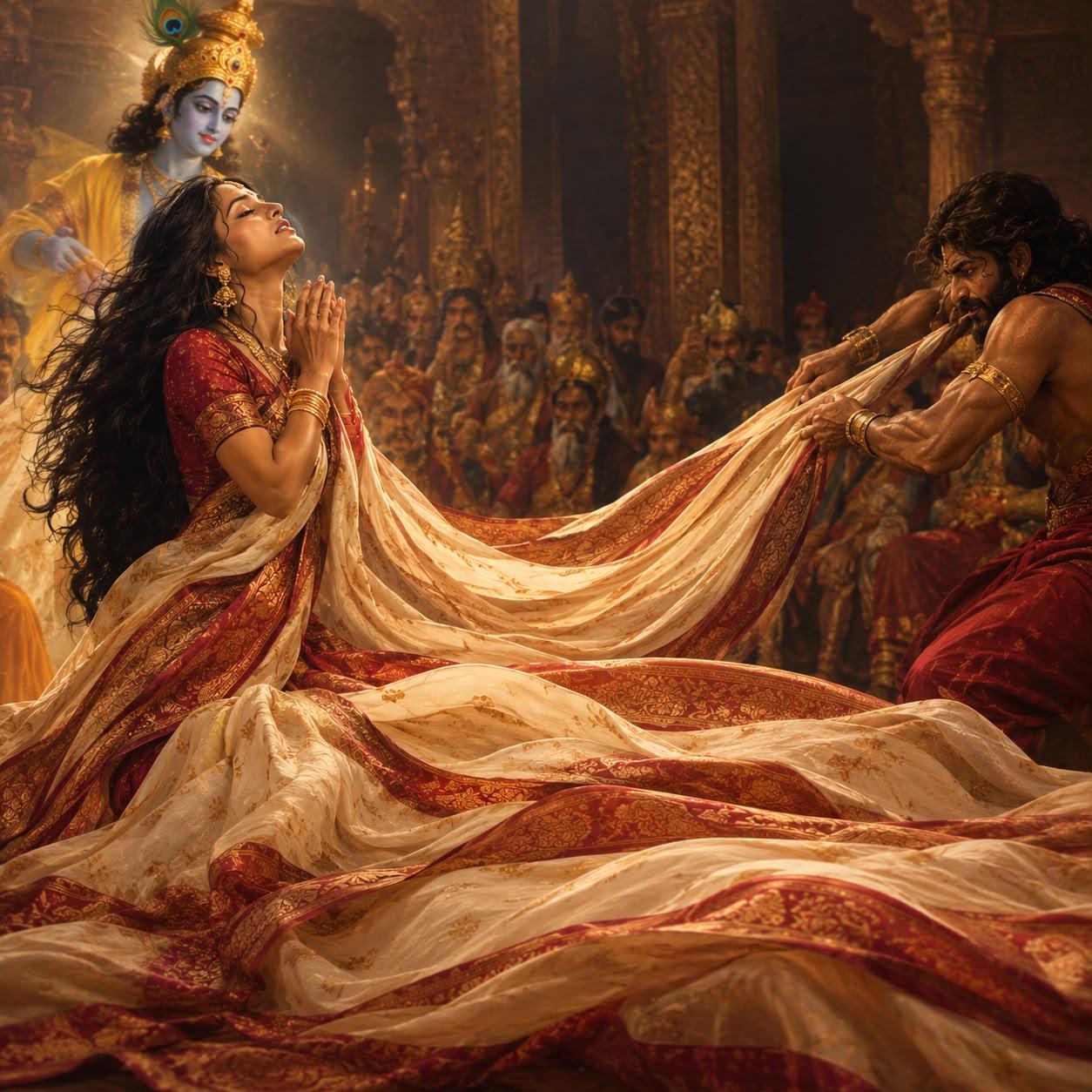
The Mahabharata’s darkest turn comes after the dice game. Yudhishthira loses everything; his kingdom, his brothers, his freedom and finally Draupadi. She is dragged into the court of Hastinapur by her hair and the humiliation follows is the cheer haran.
Dushyasana is ordered to disrobe her in front of the entire assembly. She looks around that hall for someone to speak, but all the elders sit there, heads bowed, saying nothing. So she doesn't beg the courts. She closes her eyes and calls on Krishna and the SAREE answers. Dushasana pulls, and the cloth keeps coming- fold after fold, yard after yard, endless. The more he pulls, the more there is.
At that moment the SAREE stops being a fabric. It becomes Dharma standing where assembly failed to. It became divine protection; the SAREE was what she was draped in, became a symbol. It became the voice in that hall that never went silent.
The Saree as a Muse: Radha and the Art that Authored the Drape
In Vrindavan, the SAREE carries a different energy. It isn’t a shield; it’s a CELEBRATION.
Over time that celebration became a visual language - one in which the artists didn't simply paint the drape, they helped define it.
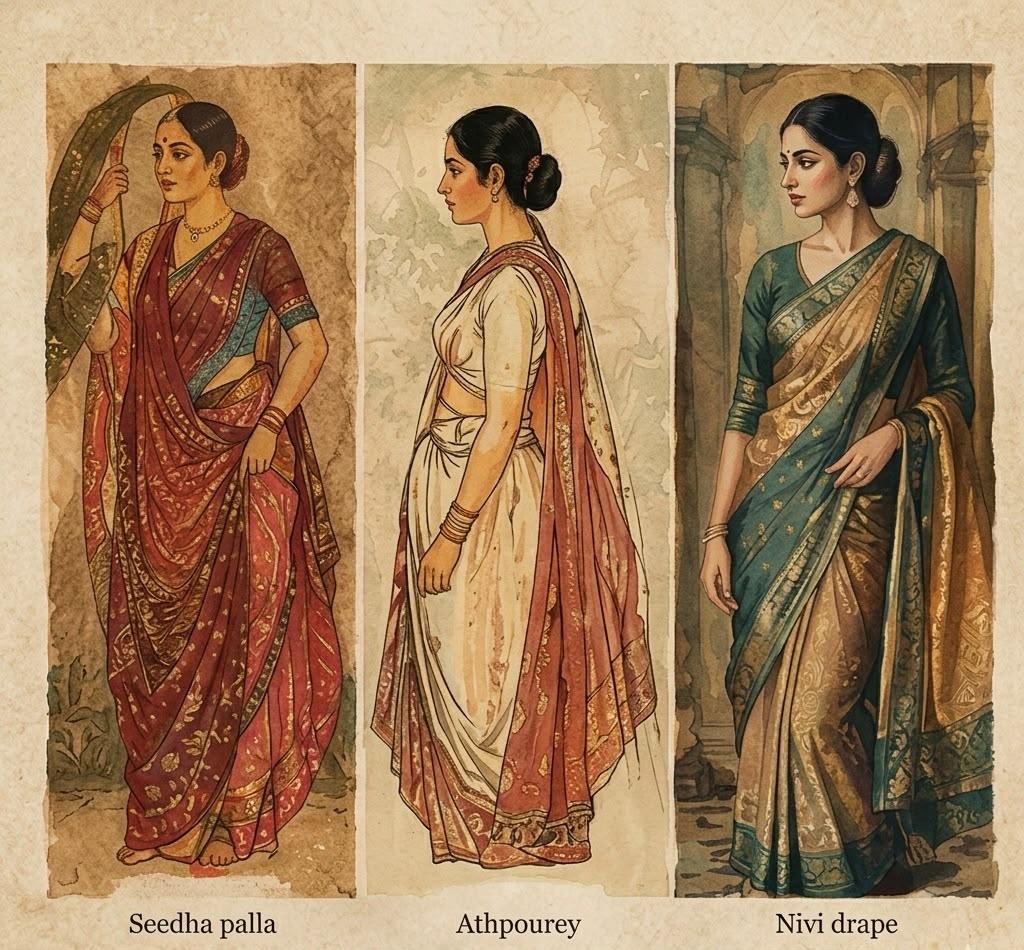
In Nathdwara’s Pichwai tradition, Radha appears in the Seedha pallu: brought forward, pinned, and fully visible. In Bengal’s paintings, the Athpourey offers another silhouette - one continuous loop, spare and almost sculptural. Later, Ravi Varma’s widely circulated images brought the nivi drape, with its neat front pleats, into the popular imagination. The art didn’t just reflect the drape. The art set it.
That history matters when we talk about sarees today. There has never been just one way for a saree to look or one story it can tell.
The Drape as Reinterpretation
Artists like Raja Ravi Varma didn't just paint sarees; they defined new drapes that altered how society viewed the garment.
In the preloved space:
The Saree is an Unfinished Canvas: A preloved saree brings a history, but the new owner's drape gives it a new form.
Styling as Sovereignty: Just as Pichwai painters brought the pallu forward to celebrate Radha (seedha pallu), a preloved buyer can take a saree steeped in tradition and completely reinvent its silhouette using modern drapes. The garment adapts to the individual, not the other way around.
Worn Before, Waiting for You: Still Beautiful, Still Auspicious
Resilience and Memory: The Saree Does Not Forget, but It Outlives the Tear
A preloved garment may bear marks of its past: a torn edge, a missing thread, or a history tied to difficult moments. Yet, like Gandhari’s saree, these alterations do not destroy its purpose or beauty. Wear and history do not invalidate a textile; they turn it into a physical witness to devotion, strength, and endurance.
Inexhaustible Grace and Sacred Continuity
The essence of a saree is infinite; its purity and beauty are inexhaustible. It retains its divinity and grace through every trial, proving that true value isn't consumed by use; it is preserved by its inherent spirit.
Renewal, Movement, and Re-imagination
In Vrindavan, the saree leaves behind tragedy and constraint to become dynamic, vibrant, and celebratory. Through the hands of artists and the energy of the Raas Leela, the drape is constantly re-interpreted and given new life.
Preloved fashion isn't about accepting "used" items out of compromise; it is an act of artistic re-imagination. Just as artists defined the visual language of the drape over generations, a new wearer redefines a preloved saree, infusing fresh celebration into a canvas created long ago.
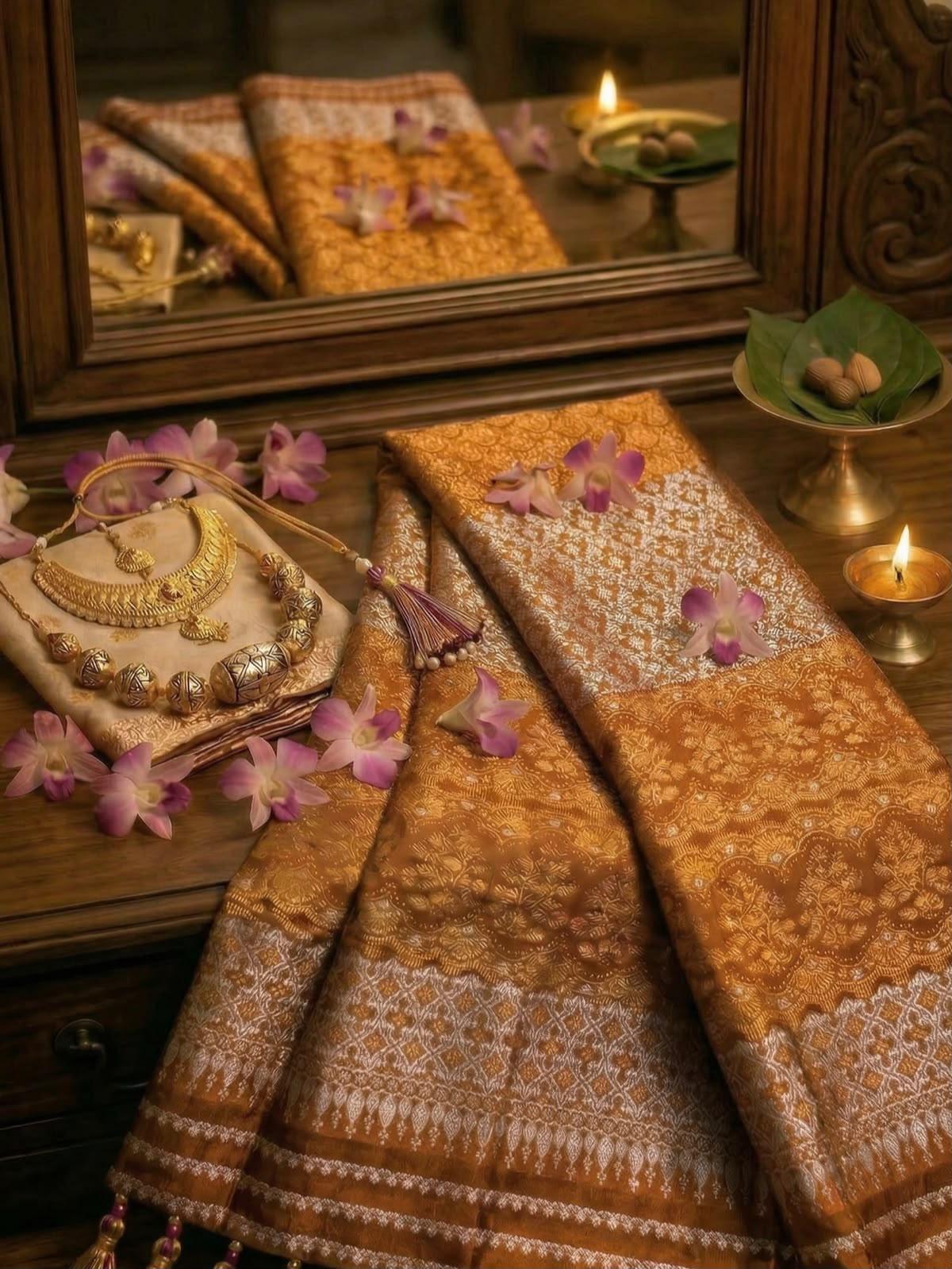
Is It the Cloth or the Intention that Makes It Auspicious?
Auspiciousness is not an inherent chemical property of untouched fabric; it is an energetic charge imparted by the intention, devotion, and context with which it is worn and given.
The Pitambara and Devotional Offerings: Woven with Bhakti
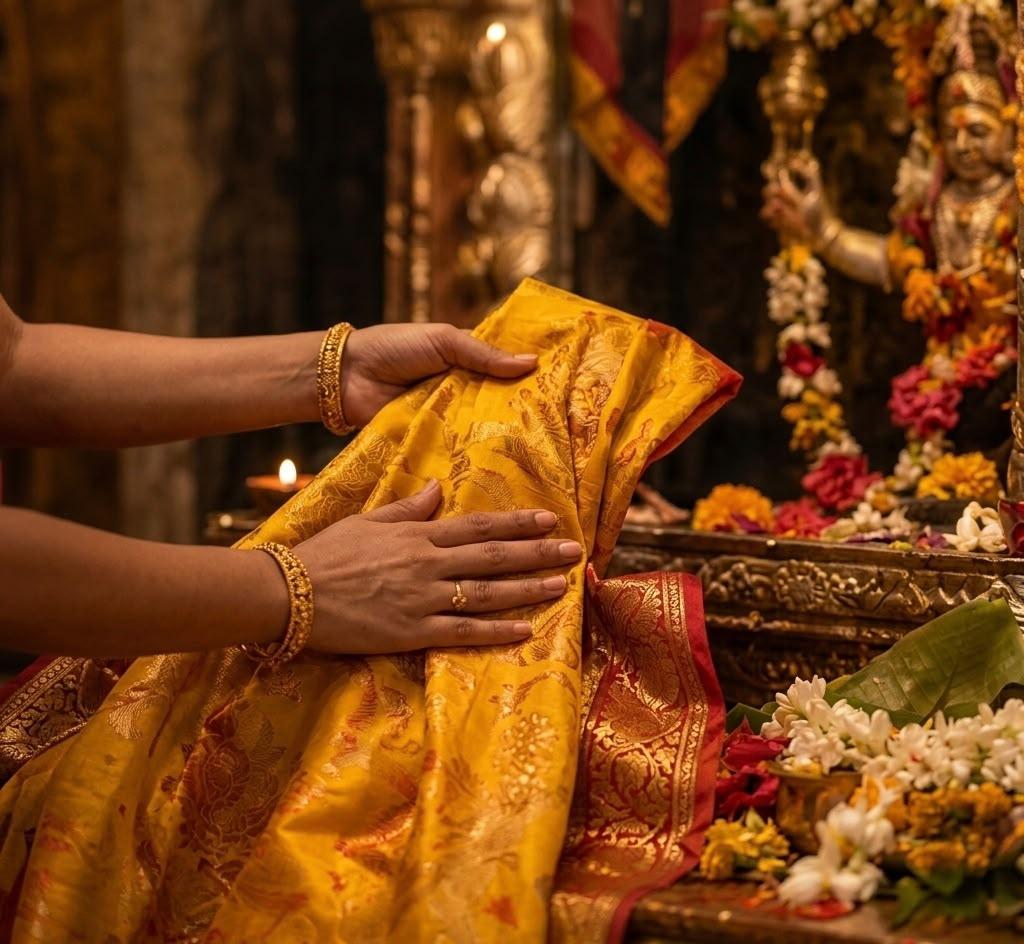
Sacred idols in ancient temples are adorned with sarees donated by ordinary women; sarees that were purchased with deep devotion or handed down through families to be offered to the Mother Goddess (Devi).
Once a saree is offered to a deity or worn during a sacred ritual, it becomes Prasad. A preloved saree passed down through generations from grandmother to mother to daughter is the domestic equivalent of Prasad. The affection and blessings elevate the cloth to a sacred heirloom.
Sant Kabir and the Loom of Consciousness
The 15th-century mystic poet Kabir, a weaver by trade, composed the iconic bhajan "Jhini Jhini Bini Chadariya" ("Finely Woven Sheet"). He used the woven sheet as a metaphor for the human body and soul. Kabir speaks of how the sheet is worn by gods, sages, and mortals alike it passes through hands, experiences, and time, yet its intrinsic divine nature remains pure if kept free from ego.
From the Epic to the Everyday: UNNEU
In modern textile culture, we often practice an involuntary blindness choosing not to see the lifecycle, labor, or environmental impact behind what we wear. Reclaiming a preloved saree flips Gandhari's tragic choice on its head: it is an act of choosing to see. It acknowledges the history of the garment, honoring the hands that wove it and the lives it touched rather than discarding it for something unblemished and new.
From Draupadi’s endless saree in familiar retellings to Radha’s Seedha pallu, Athpourey, and Nivi drapes in art, the saree never appears in just one way. In Draupadi’s story, it becomes a sign of protection, in paintings of Radha, its folds and pallu help express devotion. Those images make us look closely at the drape - not just the figure wearing it.
UNNEU isn’t recreating mythological costumes. It resells pre-loved sarees: real apparel that have been worn and are ready to be chosen by someone else.
Sustainability as Sadtrikarma: In ancient Vedic thought, non-wastefulness (Aparigraha) and sharing (Dana) are spiritual virtues. A preloved saree embodies both; it honors the earth and celebrates connection over consumption.
A new saree is an unwritten page, but a preloved saree is a legend already in progress. It has absorbed the sacred, the tragic, the resilient, and the joyous. To wear it next is to participate in a lineage: Still Beautiful, Still Auspicious, and Waiting for You.