

Somewhere between the second and third Instagram reel of the night, a woman who is definitely not shopping, stops scrolling. A vintage Banarasi drifts past mid-swipe, captioned like "a wardrobe you didn't know you were allowed to want," and something in her chest does a small, illogical flip. She isn't shopping. For a second, she's time-travelling. That flip is the real starting point of India's fastest-growing fashion habit.
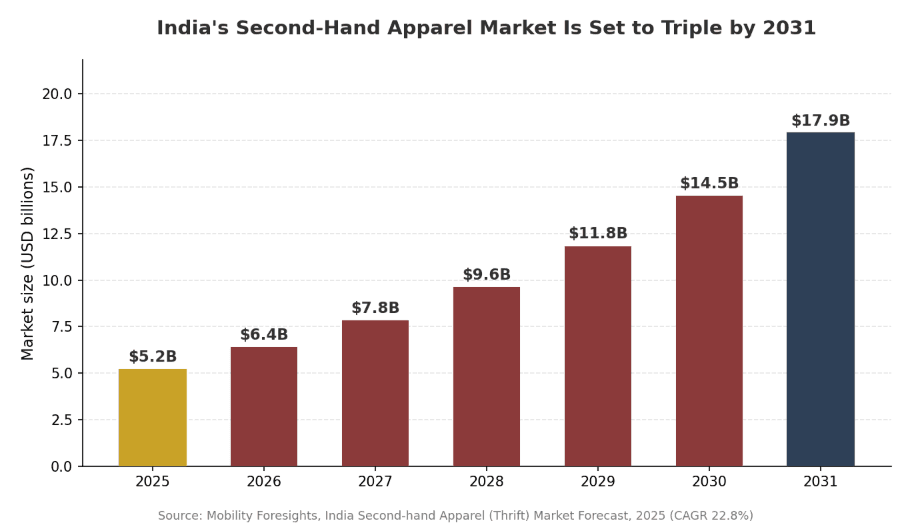
The user interview was conducted with 15 preloved saree buyers, including an IT professional who wanted a certificate before she wanted a saree and followed that flip all the way to checkout. Their instincts line up with the numbers: India's second-hand apparel market, worth roughly $5.2 billion today, is on track to hit $17.9 billion by 2031, growing almost 23 percent a year. (Source: Mobility Foresights, "India Second-hand Apparel (Thrift) Market Size and Forecasts," 2025.) This deserves a better explanation: the less-seen weaves, the surprising colors, the thrill nobody quite admits than "sustainability" and "discounts."
The Romance of the Backstory
"Every preloved item has lived a life before it reaches you" that was the brief. Those 15 buyers would agree without hesitation. Nearly all of them described their first preloved saree the way you'd describe a hand-me-down from your mother's cupboard, not a purchase from a stranger online proof, they said, that older weaves used pure zari and sturdier thread than most of what's sold new today. One vintage collector said it better than any of us could have.
"Buying a preloved saree feels like writing a new chapter with someone else's pen."
It's an intimate thing to say about a stranger's wardrobe, and it explains why buyers forgive a saree so easily for having been worn before. A backstory only stays romantic if it's told honestly: a tear near the pallu, a blouse cut short, a powerloom quietly passed off as handloom. Buyers make peace with nearly all of this, provided they're shown it before they buy rather than discovering it after the parcel is open. The best experiences we heard about shared one detail: someone, unasked, sent a close-up video of exactly where a flaw sat. Not customer service but just a story, told properly, flaws included.
The Thrill of the Hunt
The algorithms do away with the element of surprise since they predict what the consumer wants and saturate the market with similar products. Preloved fashion operates the other way around. Nothing is promised and finding the right piece requires patience and luck. The vast majority of new customers come in through Instagram and are reluctant to buy a saree from someone they don’t know. Most of them make their first purchase just like a test to see whether it will satisfy their demands. Once satisfied with the first purchase, subsequent purchases are easy.
Here comes the psychological part. The "Sold Out" sticker doesn't discourage customers but rather prompts them to buy the next time quicker. For vintage collectors, rarity is the charm. They seek out discontinued weaves and regional fabrics in India, regardless of distances. If there is a customer from Chennai who needs Chikankari, the person from Lucknow seeks Kanjeevaram.
A Rebellion Against the Disposable
Choosing "preloved " is a quiet but powerful counter-cultural act though "quiet" undersells the size of the problem it's rebelling against. India generates upward of 7,800 kilo tonnes of textile waste every year, (Source: CSTEP, "India's Fashion Paradox: As the Industry Booms, It Is Being Buried Under a Heap of Its Own Waste," 2025) even as the country produces roughly 95 percent of the world's hand-woven fabric. (Source: Press Information Bureau, Government of India, Ministry of Textiles, "National Handloom Day 2025”).
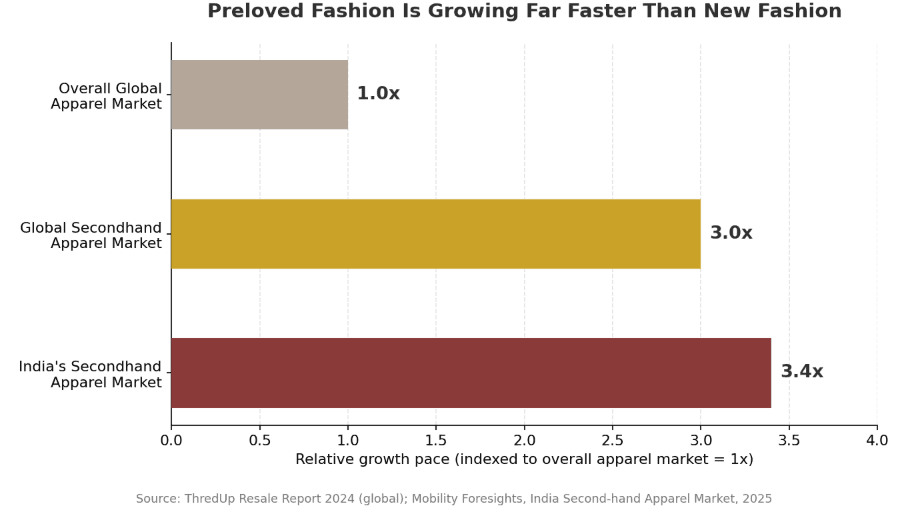
Buyers seem to sense the mismatch instinctively. They told, unprompted, that they feel good knowing their money helps another woman turn her closet into cash instead of clutter, that a beautiful weave gets to keep living instead of becoming landfill. It stops being a transaction. It becomes a small, quiet rescue, dressed up as a shopping cart. The market is rewarding that instinct too: the global preloved apparel market grew roughly three times faster than the broader apparel industry in 2023, a gap that runs wider still inside India.
The Expression of Unfiltered Personal Style
When you buy preloved, you get access to decades of design history at once: a 1970s Bengal cotton beside a 1990s Banarasi beside a weave nobody makes anymore. What nobody mentions is that this freedom comes with its own quiet arithmetic. A buyer flatly called financial genius.
“When I realised a saree worth ₹40,000 was available for around ₹6,000, buying preloved immediately made sense.”
Buyers run a private cost-per-wear formula on everything: an occasion saree worn twice a year has earned its steep discount; a daily cotton with only a ₹1,500 gap from retail hasn't, so they simply buy it new.
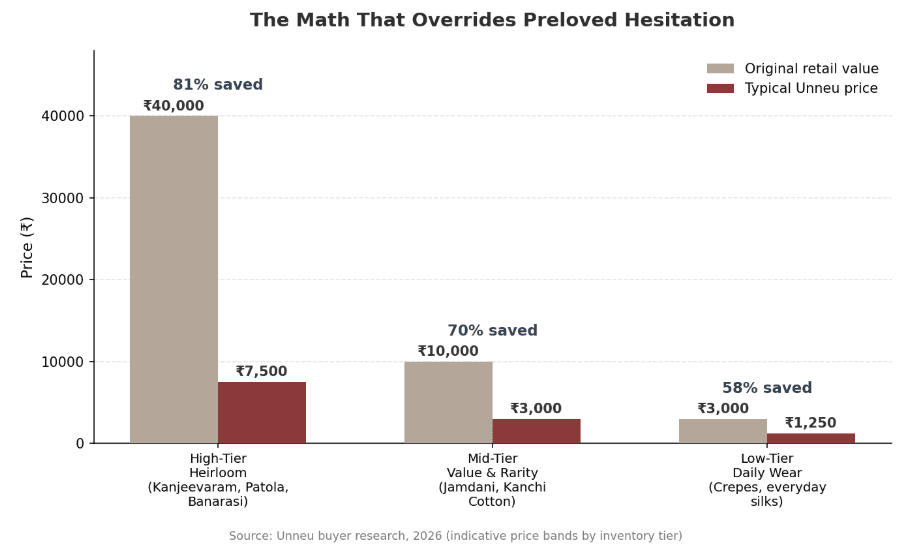
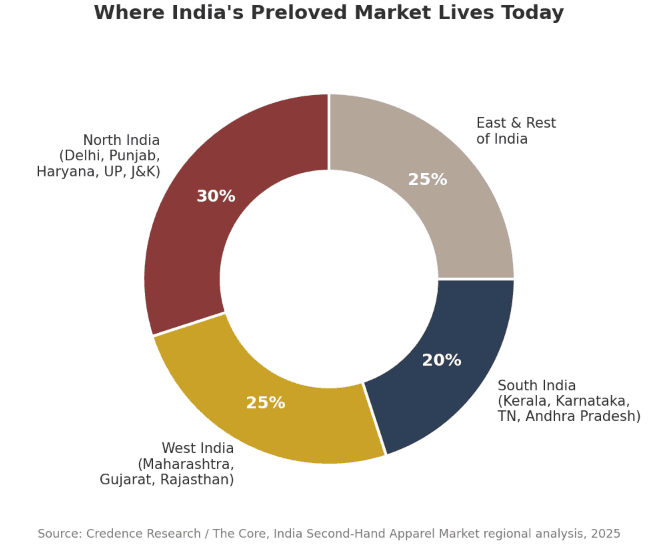
That math is really what makes the style possible. A wardrobe built only from what's in stock at full price is, by definition, filtered and shaped by whatever the market decided to produce this season. A wardrobe assembled from three price tiers, five decades, and a dozen regional weaves is something closer to unfiltered. Nobody else is likely to be wearing the exact same piece, in the exact same color, with the exact same border and increasingly, nobody has to live in a metro to find it. Tier-2 and Tier-3 cities are now the fastest-growing part of the map, chasing the same freedom as everyone else. (Source: Credence Research, "Thrifting Takes Off in India, But the Industry Has Miles to Go," 2024.)
The Takeaway
Strip away the research language and what's left is tender, almost embarrassingly so. Nobody falls for a preloved saree because of a discount code. They fall for the math that makes an heirloom reachable, the small ache of watching something rare disappear, the comfort of a story like their own mother's closet, and the relief of a seller honest enough to show them the flaw first. One of the buyers even said:
“I’m not buying it because it’s sustainable or cheap. I’m buying because these designs simply aren’t made anymore.”
The user interviews of the 15 preloved buyers, conducted by UNNEU, the curated preloved sarees platform was built around one instinct: a buyer's choices and hesitations should shape the shelf they shop from, not the other way around. A preloved saree will rarely be perfect the way a new one promises to be. It will almost always be more interesting carrying a weave, a history, and a small human story no factory has learned to manufacture.
Selling the preloved, one weave at a time.