

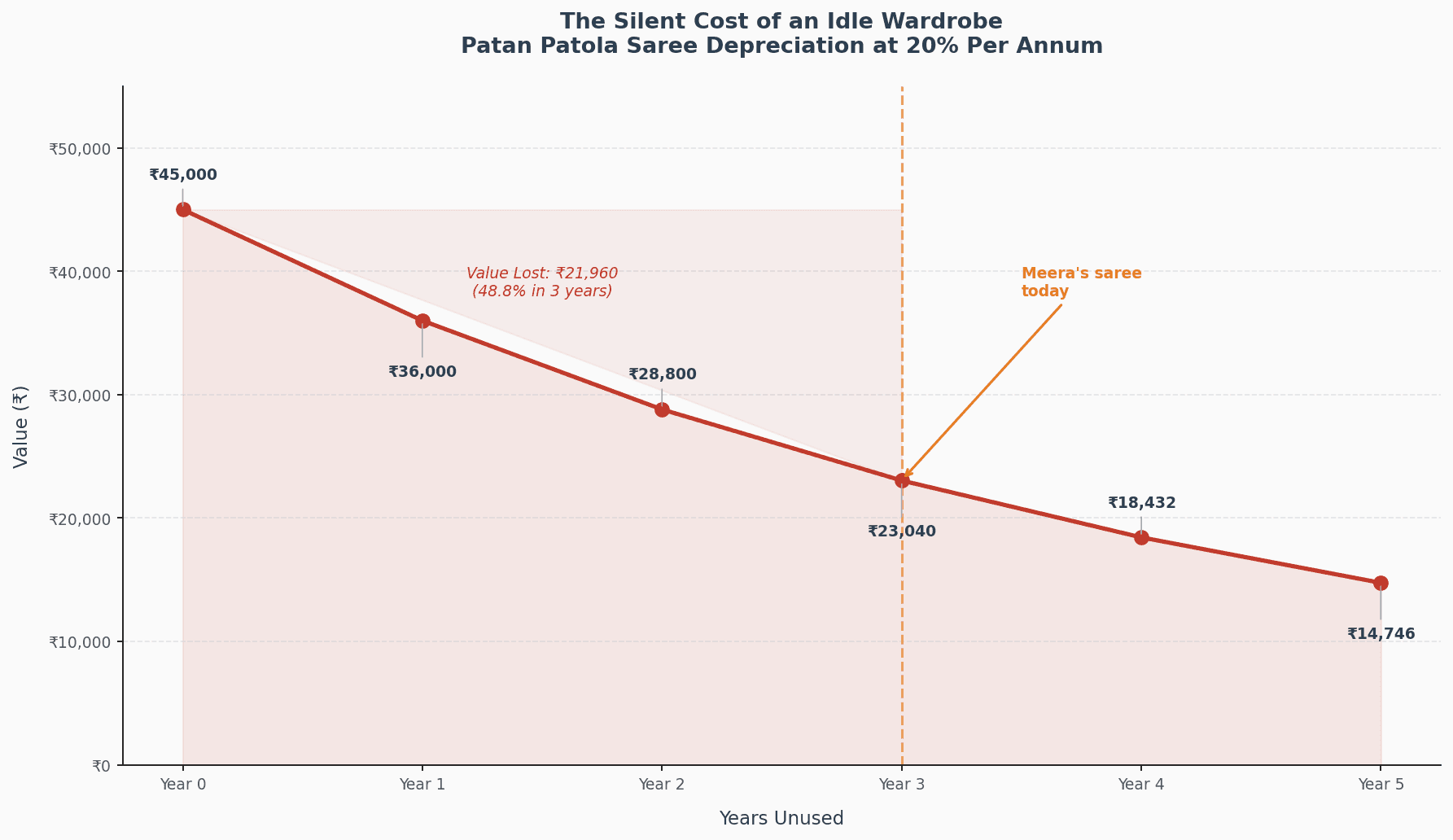
The Patan Patola saree that Meera owns has been worn once by her cousin in a wedding ceremony three years ago in Jaipur and it cost ₹45,000. Currently, the saree is safely packed away because she thinks she will wear it again someday. Kavitha, meanwhile, is getting ready for a client’s dinner at her office. She is searching for something different from her usual churidar kurta. She does not have ₹45,000. She has ₹5,000.
Between Meera and Kavitha lies a potential that India has only recently begun to recognise. Meera recovers real money from something sitting idle in her almirah, while Kavitha gets to walk into that client's dinner looking the part without paying anything more than a fifth of what the saree originally cost. This is ReCommerce where the economic correction is hiding inside millions of almirah in India. But to understand why it matters so deeply to India, you need to look at the numbers behind the story.
The Cost of Lifestyle Paradox
India’s per capita income in FY 2023-24 stood at around ₹1,84,205 per annum, or about ₹15,350 per month. This is the national average, which suggests that half the population earns less than this number. In Tier-2 and Tier-3 cities, the median income of households tends to be closer to ₹10,000-₹18,000 per month. (Source: National Statistical Office, India (FY2023–24)
On the other hand, lifestyle spends have increased drastically. Indian households are spending more money on non-essentials such as clothing, gadgets, grooming, and mobility expenses. The disparity between what people are earning and what the market is providing to them has never been higher. (Source: Household Consumption Expenditure Survey, 2022-23)
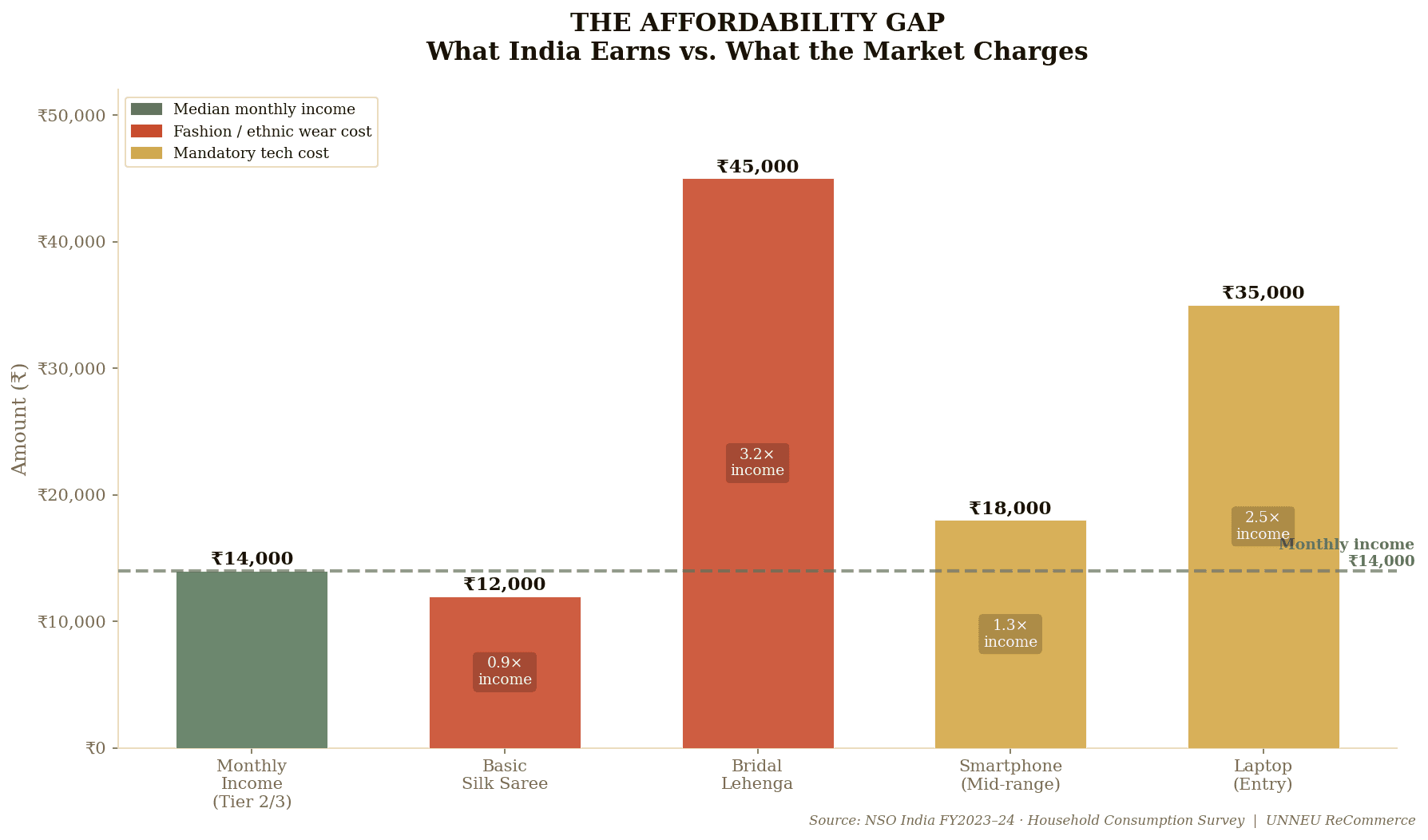
Consider what the market actually charges for a pure silk saree ranging from ₹12,000-40000 or a bridal lehenga for ₹40,000 and upward, worn once. A single purchase can wipe out an entire month’s earnings and inflation running above 5%, keeps widening that gap every year. This is where the concept of cost-per-wear becomes not just smart finance, but essential economics.
What is Driving Indians toward Pre-owned?
With all this in mind, it becomes clear that moving towards ReCommerce is not just a trend; it is a natural reaction to three factors that reached a critical point explaining the faster development of India’s pre-owned economy compared to its first-hand one.
Inflation consistently outpacing salary growth has quietly eroded buying power, making goods that once felt accessible drift out of reach for a large portion of the middle class. Simultaneously, social media has made brand consciousness unavoidable across every income bracket, placing the Indian middle class under visible, daily pressure to own the right phone, wear the right outfit, and show up the right way. And crucially, certain purchases are no longer optional. A smartphone, a laptop, presentable work attire, these are no longer luxuries but entry points to the modern economy. When new retail prices make those entry points inaccessible, ReCommerce does not just become attractive. It becomes necessary.
The Concept of Cost Per Wear Changes Everything
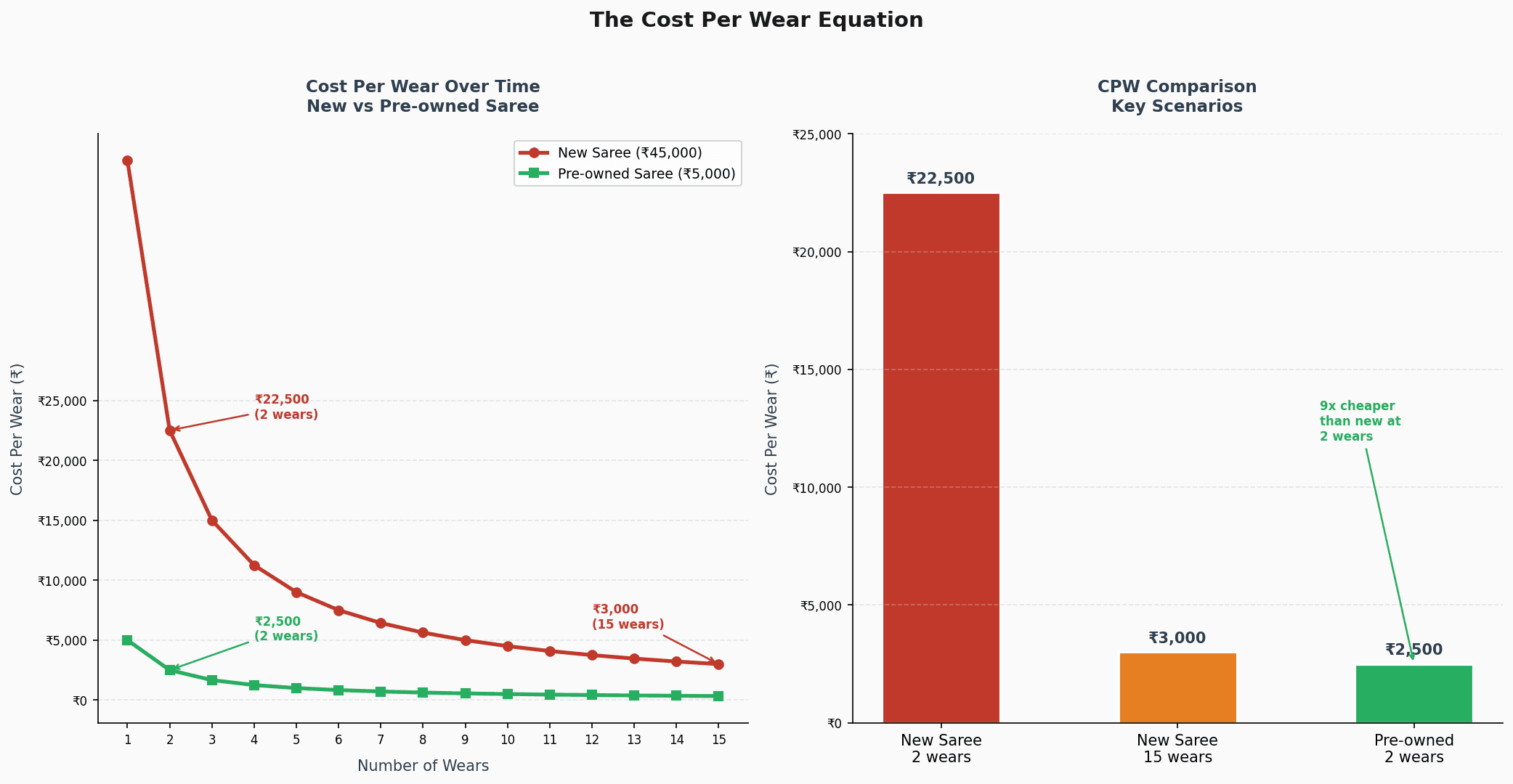
The math of pre-owned goods is not just about paying less. It involves a different way of thinking about each purchase made. Consider the Patan Patola saree Meera owns, purchased for ₹45,000 and worn just twice. That is ₹22,500 per wear. If she commits to wearing it 15 times over its lifespan, that CPW drops to ₹3,000, which is far more reasonable. But that requires discipline, occasion, and time. Now consider Kavitha, who buys the same saree pre-owned for ₹5,000. After just two wears, her cost per wear is already ₹2,500, lower than what Meera would achieve only after 15 wears of a saree that cost her nine times as much. The pre-owned saree is a financial win from day one. The new saree has to earn its value back wear by wear, year by year, with no guarantee it ever will.
The difference is not marginal. It is 45 times.
Selling sooner means reclaiming more. Waiting means losing silently. In India, where the ethnic wear market exceeds ₹1.5 lakh crore and occasion-specific outfits are routinely worn once and forgotten, that silent depreciation adds up to an enormous, invisible financial loss spread across millions of households. A wardrobe full of expensive, unworn clothing is not a treasure. It is a liability quietly draining value with every passing year.
Pre-owned fashion offers a direct correction. Indian resale platforms have recorded 30 to 40 percent year-on-year growth, driven by younger buyers who understand that value is not found in price tags but in use. Cost per wear reframes the essential question. It moves the conversation away from what something costs at the point of purchase toward how much work it will do over its lifetime. That single shift in thinking changes everything about how a wardrobe is built.
What is true for one wardrobe is true for a billion of them.
Why Can India Not Look Away?
The numbers have already told that story. What they cannot fully capture is the weight of aspiration sitting on top of those incomes. The gap between what India earns and what India wants to own is not a cultural contradiction. It is a structural market failure. Recommerce is the correction.
Nowhere is this more visible than in the trade numbers. India has previously ranked as the world’s top importer of used clothing, with imports of secondhand garments worth $182 million in a single year, accounting for over 4 percent of all global used clothing imports. (Source: BusinessStandard.Com) The exporting nations are overwhelmingly from the Global North, with the US, UK, and Germany leading the list. There is a structural irony buried in that data. A country whose almirahs hold millions of barely worn silk sarees, sherwanis, and embroidered dupattas is paying foreign exchange to import someone else’s cast-offs. Two thirds of collected used clothing from the Global North is commercially exported for reuse in developing countries , framed as charity but functioning as trade. India does not need to be on the receiving end of that equation. It has enough idle value within its own borders to build a thriving domestic ReCommerce economy, one that keeps money, craft, and resources circulating among Indians rather than flowing outward.
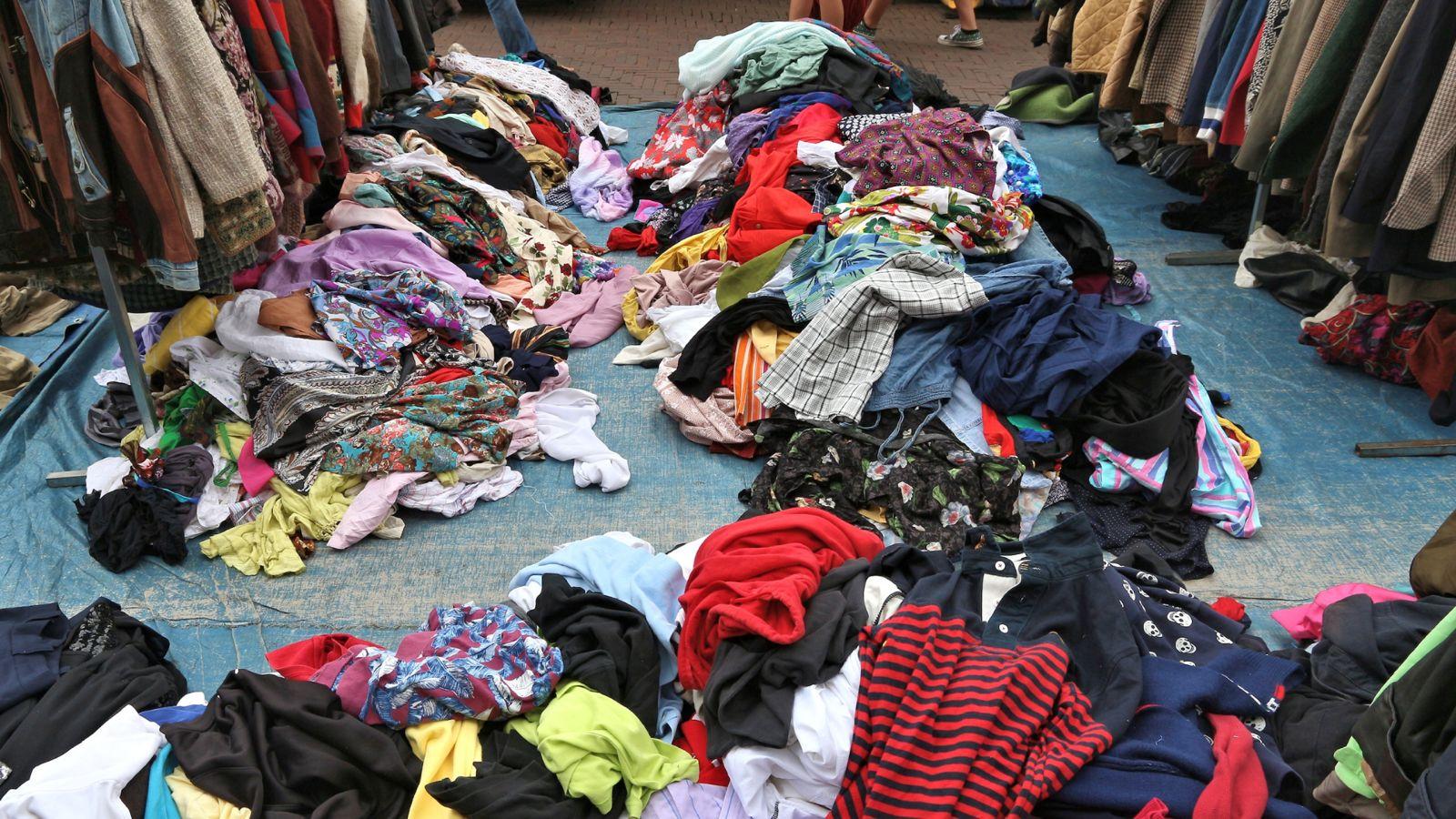
The cost, however, goes beyond money. India generates an estimated 7.8 million tonnes of textile waste annually, much of it from garments worn once and forgotten. Every pre-owned transaction does not just recover money. It recovers the water, labour, and craft that went into making the piece in the first place. Recommerce does not just solve a personal finance problem. It quietly solves a national one.
UNNEU: Built for the Way India Actually Lives
India has always known the value of making things last. What it needed was a system built around that instinct. UNNEU is built for every Meera whose almirah holds value she cannot see, and every Kavitha who deserves quality she cannot yet afford at full price. Every listing is idle value put back to work. Every transaction is income stretching further, with zero compromise and zero waste.
The circular economy is not an ideology. For most Indians, it is simply the most intelligent way to live. When ReCommerce recovers money, reduces waste, and gives millions access to quality that new retail keeps just out of reach, it stops being about fashion.
ReCommerce becomes about financial dignity. UNNEU is built to make that possible.