

Unneu functions as a digital re-commerce platform and peer-to-peer marketplace. As people popularly choose to state that sarees are best felt through sensory experiences so we just got our manifestations realised recently with a right set of audience.
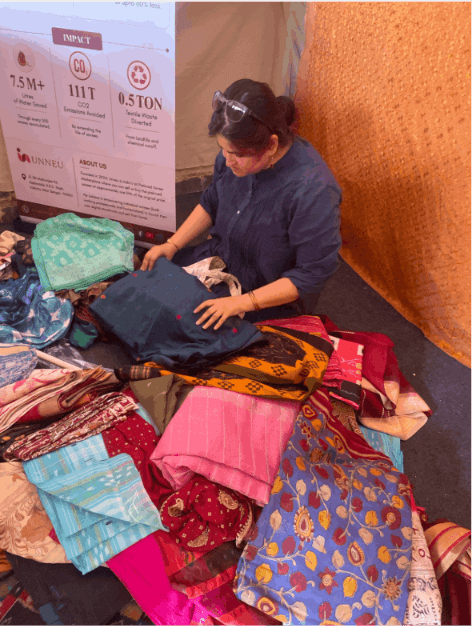
Securing a spot at Weave the future 4.0 alongside 100 curated brands was a huge milestone for us, but the real reward was the overwhelming response from attendees. We walked into the exhibition with an open mind and walked out with absolute validation: we aren't just building a product we are opening up an entirely new category within a massive ocean of latent consumer demand.
People kept saying the same thing: preloved buying feels better because it hands you the vintage quality, the sense of community, and the real craftsmanship that new clothes just don't have anymore.
One buyer put it best while running her fingers over a forty year old Banarasi: "This is the real silk. Today's silk is silk only by its name.”
She wasn't wrong. Most "pure silk" sarees sold today are quietly blended with polyester and viscose to cut costs, something a 1960s saree simply never had to deal with.
Apart from the praise for the material, buyers saw their buying as a discovery rather than a mere transaction, like a kind of treasure hunt, and celebrated the saree discovered irrespective of its price being preloved and thus affordable or sustainable have all been said before; rather, it was due to the essence of the pre-online market dynamics, including its unspoken conventions, which solved issues that retail today still finds difficult to tackle when it comes to the saree as something more than just a purchase, but a cultural heritage and a story too.
So what exactly did that Pre-online Era get right? It starts with something as simple as how buyers knew what they were buying was real.
How Markets Verified Truth Before Google Existed
Before there were reviews, ratings windows, there was the rubbing test and the draping test around the body to understand how it might look on the buyer. Every serious buyer at a 1960s-90s cloth market knew the moves: rub the pallu between two fingers to feel the weight of real zari, hold the fabric up to sunlight to check the weave density, do a tiny burn test on a loose thread to see if it curled and smelled like burnt hair (real silk) or melted into a plastic bead (synthetic) and draping the saree around the body as a trial. Nobody needed a lab certificate. These trial tests were the certificates.
That entire ritual vanished the moment shopping moved into malls with sealed packaging and fixed price tags. You stopped touching before buying. You started trusting a label instead of your own hands and labels, as that Dilli Haat buyer pointed out, can say whatever a factory wants them to say.
Preloved shopping is quietly reviving these tests, just in digital form. A genuine preloved saree listing today comes with macro shots of the weave, honest notes about small snags or watermarks, and sometimes even video of the fabric catching light. It is the same fingertip logic from the offline store shopping, translated into a phone screen, because a seller who actually owned the piece has nothing to hide and everything to show.
But verifying the fabric was only half the equation. The other half was knowing who to trust in the first place.
Trust That Traveled Through Relationships, Not Ratings
Nobody in the 1980s-90s typed "best saree seller near me." You asked your aunt, who asked her neighbour, who had bought from the same Chandni Chowk shop for fifteen years and would happily walk you there herself. Reputation moved through relationships, not ratings. A seller's worth was measured in how many weddings his fabric had survived, not how many stars rated under his name.
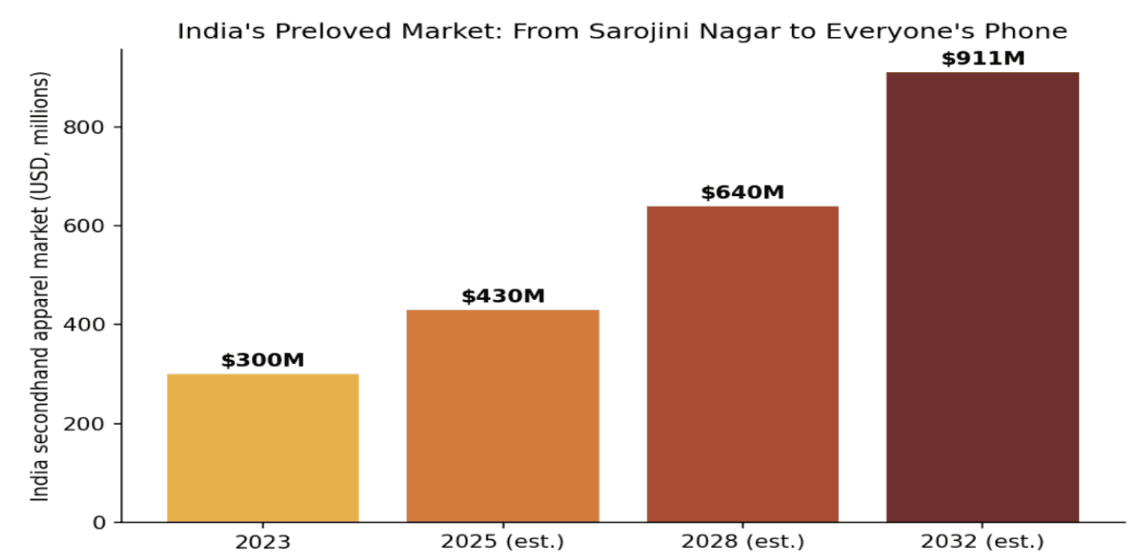
This is the part modern preloved platforms in India are rebuilding. Word of mouth never left, it just found new pipes: a WhatsApp community group forwarding a preloved Kanjeevaram listed in the Preloved Platforms, or a buyer tagging a friend under a photo of a Patola saree saying "this looks exactly like your grandmother's saree.” India's informal preloved clothing economy, estimated at roughly ₹33,000 crore a year still runs largely on exactly this kind of trust chain, just with better internet.
Trust, once established, changed something else too: what buyer and seller were willing to talk about, including the price.
What Buyers Actually Told Us
We went to Dilli Haat with an open mind, and the response completely blew us away especially for opportunities we hadn't even originally set out to pursue. It was an incredible reminder of just how much untapped demand exists in this space.“I didn't think preloved would look like this,” one buyer told us, turning a Patola over twice before she believed the border was hand-woven.
Close behind it came familiarity. Buyer after buyer described the sarees as a memory they got to hold again. One buyer said flipping through the stack felt like being twelve again, digging through her mother's saree suitcase.
Then came the saree itself: the weave and design people examined by hand, pointing out zari work and motifs today's mass-produced silk doesn't replicate. From there, uniqueness and authenticity followed naturally, every piece was one of one, and buyers wanted that specific saree because they knew nothing else like it existed. Price mattered too, but rarely came up first; it arrived as confirmation of a good find, not the reason for it.
Negotiation was an added advantage, not an expectation, and what actually surprised us was that buyers barely bargained. They were overpowered by the initiative itself, the fact that someone had curated and verified these pieces, and that effort mattered more than shaving a few rupees off the price.
The same buyer-seller relationship was maintained even outside the buying experience. In the old market, the story of the garment continued beyond the act of buying it.
Nothing Was Ever Truly Discarded: The Repair Economy Sitting Right Next Door
The 1960s markets were never just about buying, they were built around an entire repair ecosystem sitting a few stalls away. The rafoogar mended tears so invisibly you couldn't find the original damage. Clothes were not disposable objects with a shelf life, they were possessions with an ongoing relationship to the person who owned them.
Fast fashion severed that relationship completely. A ripped seam today usually means a trip to the bin, not the tailor, because buying new is often cheaper and faster than fixing old. The preloved movement is the first real attempt in decades to stitch that broken relationship back together, treating garments as things worth maintaining rather than replacing. Globally, secondhand's share of the apparel market has more than tripled between 2012 and 2024 alone, a curve that only makes sense if you consider it the slow return of a repair-first mindset, not just a discount hunting habit.
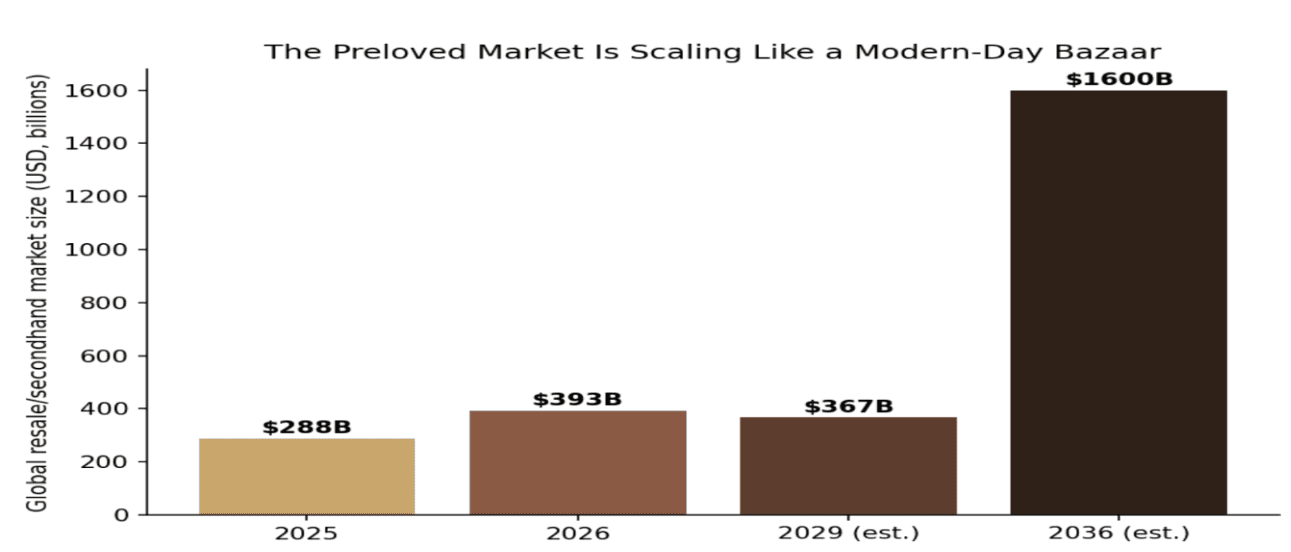
Authenticity, trust, transparent verification, and catalog variety aren't just features; they are the engines driving our entire ecosystem. Unneu is building a digital archive of pre-loved sarees sourced directly from the wardrobes of everyday Indian women, powered by mutual respect, transparency, and authentic exchange.
Making a Comeback with Curated Preloved Platforms like UNNEU
The Pre-online Era thrived on one thing above all else: trust you could actually see and that is exactly the spirit UNNEU is rebuilding, at internet scale, for a generation that grew up scrolling but is starting to crave something real again.
By focusing on curated preloved fashion, including categories like preloved sarees where authenticity, weave, and fabric purity genuinely matter, platforms like Unneu are turning online resale back into something that feels like a proper market. Recently, at the Dilli Haat Exhibition, we noticed that buyers weren't just admiring the sarees, they were reacting to the surprise of the weave and the experience.
What people kept rejoicing over wasn't a discount, it was the moment of not knowing, and then finding. That is the piece of the Pre-online Era that a fixed catalogue simply cannot replicate. It's why so many reviews from the exhibition didn't read like product feedback at all. They read like small, happy stories about a purchase journey, not a purchase.
So the next time someone tells you preloved shopping is the future, gently correct them. It's not the future. It's 2026, finally getting the comeback it deserves.